

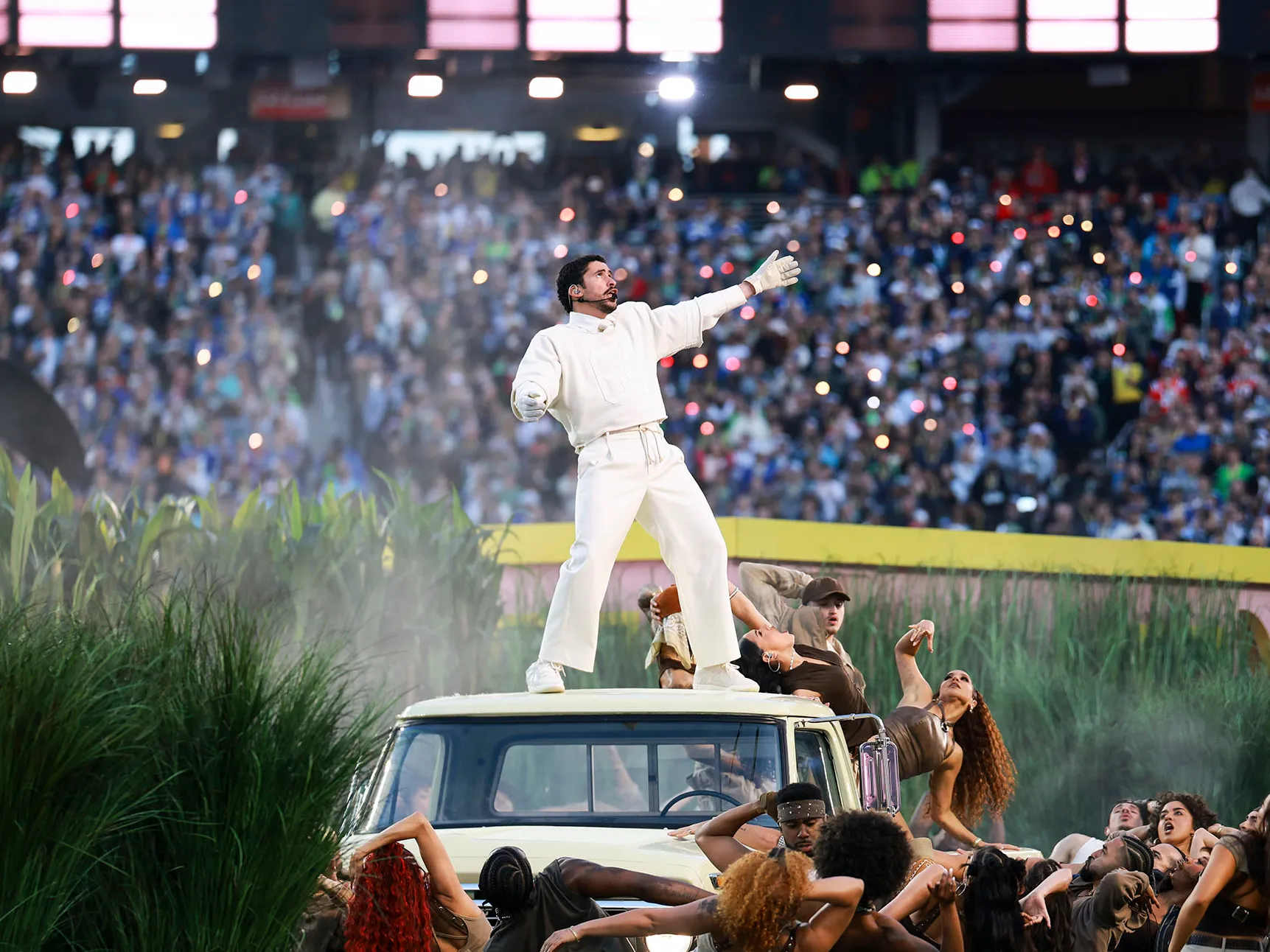
A whopping 125 million viewers watched the Super Bowl. This year, it was not just grown men butting heads — although the Seahawks did a better job of it. It was a shift in mainstream American identity, culture, and representation.
Bad Bunny’s powerful halftime performance was not just another pop culture cameo; it signaled a deeper shift in what counts as American culture.
For decades, the Super Bowl halftime show has been treated as a facet of mainstream America. It is always familiar faces, familiar sounds, and almost always English. This year was different.
Bad Bunny played different musical styles, including reggaeton and salsa, which come from Latin America and the Caribbean and are now loved around the world.
Lady Gaga, who usually performs in English, joined him on stage and danced in a salsa-style rendition of her own during the show. This crossover showed that many cultures can coexist in a show like this.
The natural reaction from most people was swift and unforgiving as he appeared unapologetically Latino and Spanish-speaking. The most common complaint was not being able to understand a single word.
This complaint ignored the reality that nearly one in five Americans is Latino and over 40 million people live in Spanish-speaking households. Spanish speakers and other non-English speakers experience this exclusion daily. For once, that imbalance flipped on America’s biggest stage.
Music is enjoyed through rhythm, emotion, and imagery just as much as lyrics. In this performance, imagery was strong. The set design was extremely powerful, and the visuals were historically significant and educational. From the aesthetics to the movement, the performance was a visual archive of Latino experience — something you could see even if you didn’t understand every word.
Non-English music is already mainstream, contrary to what conservatives might say. Bad Bunny was Spotify’s most-streamed artist globally from 2020-2022. According to a Forbes report, Latin music revenue in the U.S. outpaced the growth for all recorded music during the same period, a clear signal that Spanish-language music is expanding faster than the broader market.
Critics of his performance say their resentment does not stem from political bias. If that is the case, why has there never been such backlash against past performances, which included instrumentals, choreography segments, and multilingual performances?
As a Puerto Rican artist, Bad Bunny’s presence also highlights a major contradiction: Puerto Rico is a US territory whose residents are American citizens, yet its language is still treated as marginal. His performance and refusal to translate himself expose that contradiction in real time.
With the fabulous display at the end, where people ran with all flags representing the Americas, it clearly stated that the Americas do not begin and end with the United States. He recognized the many countries, cultures, and diasporas that exist throughout the continent.
The main reaction to this was irritation, which says less about the performance and more about who and what we’ve been conditioned to value. When something is not familiar, it’s labeled confusing or inaccessible rather than recognized.
Bad Bunny’s Super Bowl moment forces us to ask ourselves: who gets to be celebrated without translation? If nothing else, ask yourself this as a student who wants to be a member of the ever-expanding world: when you saw that performance, what did it symbolize about Puerto Rican history, and what does that mean?
As students, we can choose how we respond. We can be open to music and cultures that are different from what we are used to.
You didn’t have to speak Spanish to understand the message. You just had to be willing to listen differently. Bad Bunny puts it simply: “Yo hago lo que me da la gana”. Maybe American culture is learning to do the same, existing fully without asking to be understood first.
